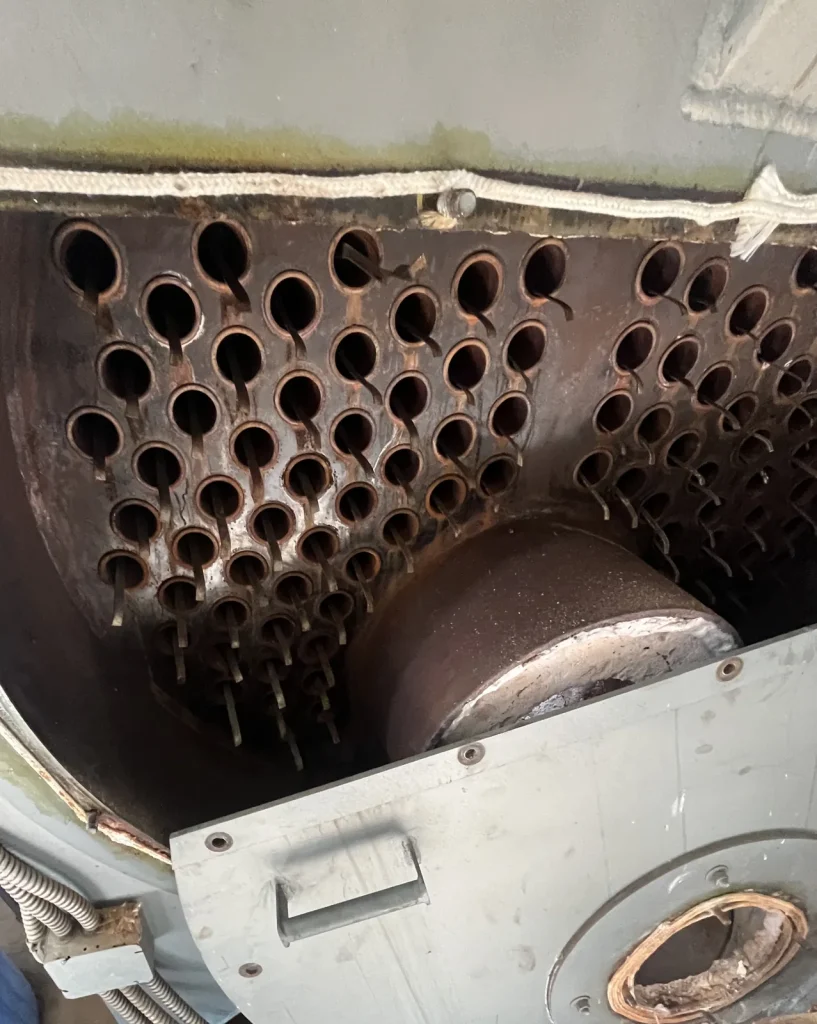
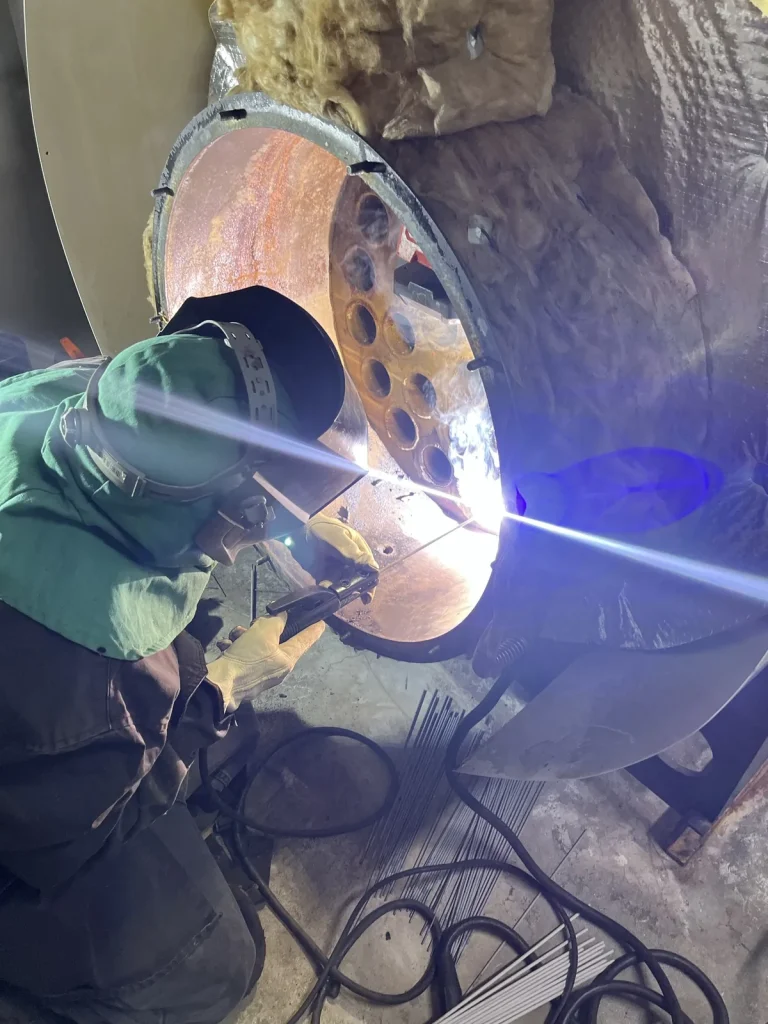
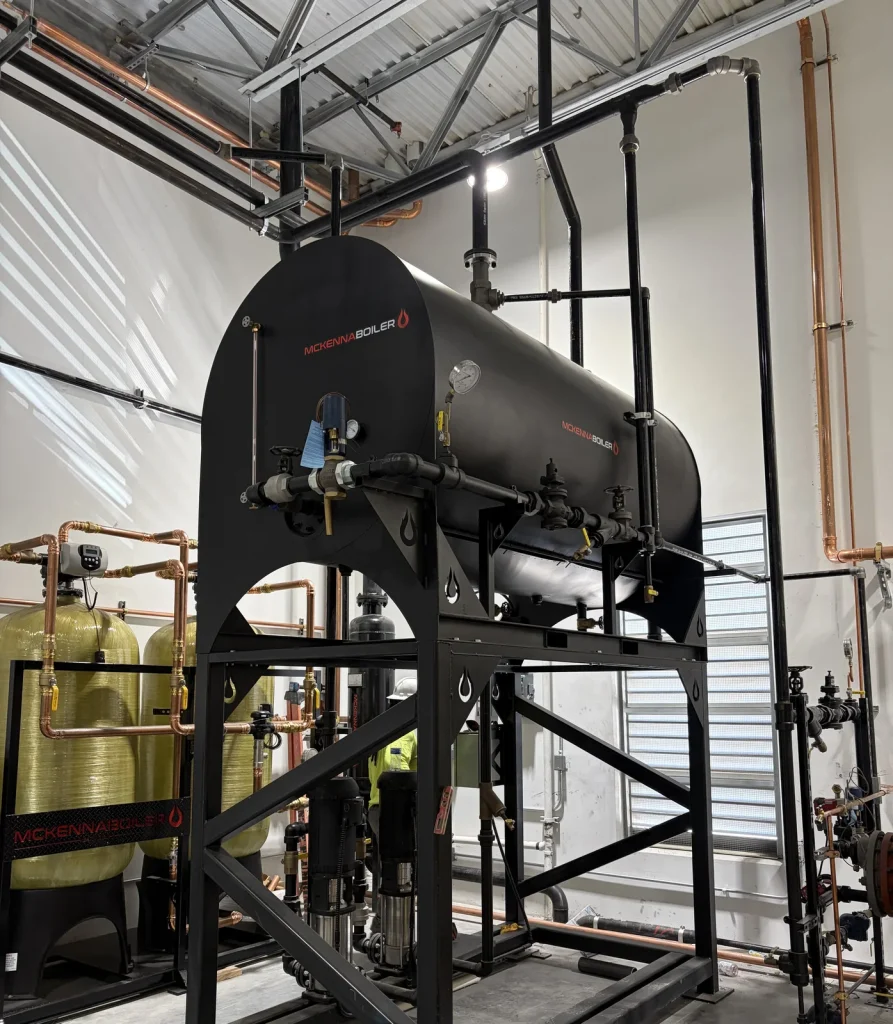
Size an industrial boiler to the peak steam or hot water load it has to carry, plus any growth you have planned, then confirm the burner can turn down far enough to run at the plant’s lightest load without short-cycling. The load is worked out in pounds per hour of steam or BTU per hour, converted to boiler horsepower, and the boiler then has to fit the room, the gas supply, and the air district’s emissions limits. McKenna Boiler Works, Inc. builds standard models or custom-designs boilers to the customer’s specifications and to fit a specific room or footprint.

How is boiler capacity measured?
Boiler output is rated in boiler horsepower (BHP). One boiler horsepower is the heat needed to evaporate 34.5 pounds of water per hour from and at 212°F, which is 33,475 BTU per hour. “From and at 212°F” means feedwater at 212°F turned into steam at 212°F. In a real plant the feedwater is usually cooler and the steam is at a higher pressure, so each pound of steam takes more heat and one boiler horsepower makes fewer than 34.5 pounds. With 212°F feedwater and steam at 100 psig, it works out to about 33 pounds per hour.
| 1 boiler horsepower equals | Value |
|---|---|
| Steam, from and at 212°F | 34.5 lb/hr |
| Heat output | 33,475 BTU/hr |
| Electrical equivalent | About 9.81 kW |
| Feedwater at full evaporation | About 0.069 gpm |
These are output numbers. Fuel input is output divided by the boiler’s efficiency, and the input rating is what the gas utility, the burner, and the air district work from.
How do you find the peak load?
Start with what the plant actually uses steam or hot water for, and at what pressure:
- Process equipment. Kettles, jacketed tanks, autoclaves, sterilizers, dryers, presses, and heat exchangers usually have a steam rating in lb/hr at a stated pressure on the nameplate or in the manufacturer’s data.
- Building heat. A heat loss calculation at the design outdoor temperature gives the heating load in BTU/hr.
- Meter data. A steam flow meter on the existing boiler gives the most direct evidence. Without one, gas meter readings taken hourly during the busiest production can be converted to output using the existing boiler’s efficiency.
- Diversity. Not every user peaks at once. Adding up every nameplate oversizes the boiler; a real production schedule shows which loads overlap.
- Warm-up loads. Bringing a cold kettle or a long steam main up to temperature can take more steam than running it, so note when those happen.
- Losses and the feedwater system. Piping losses and the steam used to heat the feedwater tank are part of the boiler’s load.
- Growth. Add only the equipment you have actually planned.
Pressure matters too. The boiler has to deliver the highest pressure any user needs plus the pressure lost in the piping. Steam above 15 psi is built as an ASME Section I power boiler, which in California needs a Cal/OSHA permit to operate and annual inspection; steam at 15 psi or below can be a Section IV heating boiler.
Why is an oversized boiler a problem?
An oversized boiler short-cycles. When the load is less than the burner’s lowest firing rate, the boiler reaches pressure, shuts off, cools a little, and starts again. Each start begins with a prepurge that blows air through the hot boiler and carries heat up the stack, and each cycle heats and cools the tube joints and refractory. Over time that wastes fuel and fatigues the pressure parts.
Turndown is the ratio of the burner’s highest firing rate to its lowest. A 10:1 burner can fire down to 10 percent of its rated input, and a 4:1 burner only to 25 percent. If the plant’s lightest load is below the minimum firing rate, the boiler will cycle. Ultra-low NOx burners can have less turndown than conventional burners at the same emissions limit, so check the turndown the burner holds at your limit.
An undersized boiler has the opposite problem. At full fire it cannot hold pressure during the peak, and as pressure drops the water level swells and the boiler is more likely to carry water over into the steam lines.
One boiler or two?
| Arrangement | Strengths | Trade-offs |
|---|---|---|
| One boiler sized for peak | Lowest first cost and smallest footprint | No steam when it is down, and short-cycling at light load if turndown is limited |
| Two boilers, each sized for part of the load | Lead-lag sequencing follows load swings, and each boiler runs at a better firing rate | More equipment to maintain and more room needed |
| N+1, with one extra boiler | The plant keeps running with any one boiler down for inspection or repair | Highest first cost |
In California, every power boiler comes off line for its internal inspection. If the plant cannot stop for that outage, plan for a second boiler or a rental boiler.
What else decides the size?
- The room. Floor space, ceiling height, door and access openings, and the clearance needed to pull tubes on a firetube boiler. McKenna builds firetube, firebox, and vertical boilers in standard sizes or custom-designed to fit a specific footprint.
- Gas supply. The meter and service have to deliver the burner’s full input at the pressure the gas train needs.
- Air district rules. Emissions limits depend on rated heat input. In South Coast AQMD, Rule 1146 covers the largest units, Rule 1146.1 covers units between 2 and 5 million BTU/hr, and Rule 1146.2 covers smaller units up to 2 million BTU/hr. The San Joaquin Valley and Bay Area districts have their own size breakpoints.
- Feedwater and condensate. The feedwater tank and pumps are sized from the boiler’s output and how much condensate returns.
What to bring when you size a boiler
- A list of steam or hot water users with their lb/hr or BTU/hr and the pressure each needs.
- Meter data from the existing boiler, steam or gas, for the busiest days.
- The production schedule, showing which loads run together.
- The lightest load the boiler has to carry, nights and weekends included.
- Planned additions.
- The share of condensate that returns to the boiler room.
- Fuel, gas supply pressure, and the air district the plant is in.
- Room drawings or photos with dimensions and access openings.
- Whether the plant can stop for a boiler outage.
Common questions
How many pounds of steam per hour is one boiler horsepower?
34.5 lb/hr from and at 212°F, which is 33,475 BTU/hr. At a real operating pressure with cooler feedwater the actual figure is lower, about 33 lb/hr at 100 psig with 212°F feedwater.
Should I add a safety margin?
Add the growth you have planned and allow for warm-up loads. Avoid stacking margins on top of a sum of nameplates, which already overstates the load because not everything runs at once. An oversized boiler short-cycles.
How much turndown do I need?
Enough that the burner’s minimum firing rate is below the plant’s lightest load. Divide the burner’s maximum input by its turndown ratio and compare that to your light-load demand.
Can I size a boiler from my gas bills?
Monthly bills show total fuel used and hide the peak, which is what sizes the boiler. Hourly gas meter readings during production, or a steam flow meter, give a much better picture.
Can McKenna build a boiler to fit my existing room?
Yes. McKenna builds standard models or custom-designs a boiler to the customer’s specifications and to fit a specific room or footprint, along with the feedwater system and trim.
For a first estimate, try the boiler sizing calculator and the feedwater tank sizing calculator, then see McKenna’s firetube boilers and installation services. To size a boiler to your load and your room, call (323) 987-1816.